1. Overview
The Online Sneaker Shop is a production-oriented e-commerce application designed to demonstrate full-stack software engineering capabilities, clean application boundaries, distributed cloud deployment, and remote database management.
While presenting an interactive storefront for browsing and purchasing footwear, the primary objective of this project was to establish an operational system that advances beyond local development setups into a resilient, production-ready cloud deployment.
2. The Challenge
Developing a local application is straightforward, but taking a multi-component system into production presents real-world engineering hurdles. The objective was to evolve a prototype into a production platform while addressing key architectural requirements:
- Decoupling the frontend presentation layer from the backend API services.
- Migrating data persistence from a local database instance to a serverless, cloud-hosted PostgreSQL database.
- Decoupling file and media assets from application web servers using cloud object storage.
- Configuring HTTPS, custom domain routing, and CORS policies across independent service hosts.
3. Architecture
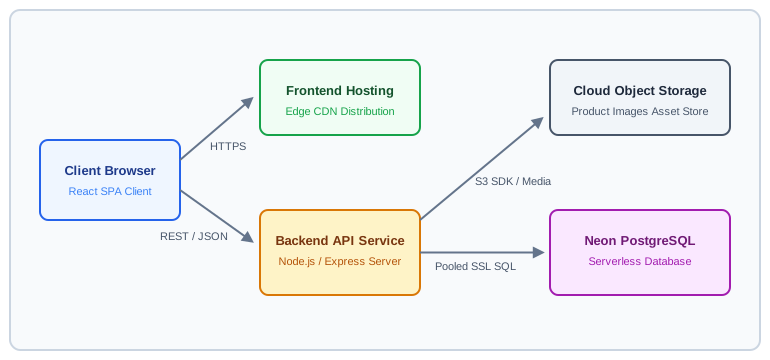
The system follows a modern decoupled client-server architecture consisting of three core tiers:
- Frontend Tier: A reactive client application built with React and modern CSS, hosted on high-availability edge static infrastructure.
- API Tier: Node.js and Express RESTful API providing business logic, authentication endpoints, and product/order pipeline operations.
- Persistence Tier: Remote PostgreSQL database hosted on Neon serverless infrastructure, accompanied by cloud object storage for media and asset delivery.
System Architecture Diagram
4. Key Engineering Decisions
1. Migration to Serverless PostgreSQL (Neon)
Problem: Initial development relied on a local PostgreSQL instance, blocking cloud deployment and remote testing.
Decision: Provisioned a Neon serverless PostgreSQL database with connection pooling enabled.
Reasoning: Neon provides full PostgreSQL compatibility, automated branch management, and connection pooling needed for serverless environment scaling.
Result: Reliable remote database connectivity with low-latency queries and zero local database maintenance requirements.
2. Decoupled Cloud Object Storage for Media
Problem: Storing image assets locally on the web server container caused storage bloat and created dynamic deployment state issues.
Decision: Offloaded image upload and serving to dedicated cloud object storage.
Reasoning: Cloud object storage provides direct URL access, global caching capability, and removes asset state from application servers.
Result: Web servers remain stateless and fast, while image loading performance improved significantly.
3. Independent Workspace Separation
Problem: The initial repository structure combined frontend and backend dependencies into a tight coupling that caused version conflicts during build steps.
Decision: Re-architected dependency boundaries to isolate the React client and Node.js backend build environments.
Reasoning: Isolated build pipelines allow packages to upgrade independently without cascading dependency breakages.
Result: Simplified continuous integration build steps and seamless cloud platform deployment.
5. Challenges & Solutions
CORS & Cross-Domain Cookie Handling
Challenge: During initial production deployment, secure session cookies failed to persist across the custom domain boundaries connecting the API backend and React client.
Solution: Configured explicit CORS headers on Express
server, enabled credentials: 'include' on frontend
request clients, and aligned cross-site cookie attributes (SameSite=None; Secure) for HTTPS environments.
6. Production Deployment
The production system is fully deployed and accessible live under a custom domain:
https://sneakers.jindasoftconsulting.com/
The deployment pipeline automatically builds and verifies frontend assets and backend service containers upon production commits, ensuring reliable uptime and continuous integration.
7. Results & Lessons Learned
Building and operating the Online Sneaker Shop established essential engineering takeaways:
- Stateless Application Servers: Separating database and object storage layers from compute containers is vital for frictionless cloud deployments.
- Production Environment Parity: Configuring production environment variables, database SSL certificates, and security headers early prevents deployment surprises.
- Pragmatic Trade-offs: Selecting serverless cloud infrastructure over raw VM provisioning reduced operational overhead while preserving enterprise reliability.